

BLOG
5 Choices You Make Every Time You Write a Post
One's philosophy is not best expressed in words; it is expressed in the choices one makes... and the choices we make are ultimately our responsibility. Eleanor Roosevelt

What? There’s something words can’t do? Yes, thank goodness.
Every writer knows that the most profound aspects of life stretch the limits of language. That’s why we seek out those liminal, wordless spaces. And, because we’re a bit mad, we then return to the desk and try to prove that it’s possible to express the inexpressible.
Regular Voyages To the Space Beyond Words
Four weekends a year I escape my responsibilities as mother, wife, and entrepreneur and I attend class at the Sacred Center Mystery School - my home for personal and spiritual development work. This is where my teacher and mentor first introduced “the goal is to become sovereign in your own reality” - the phrase that has launched my personal and professional quest for sovereignty.
What I absorb at the Sacred Center is folded into what I think Eleanor Roosevelt would call my “philosophy.” I receive teachings that both precede and supercede words. The alchemical process of turning experience into language begins when I get home and the irresistible urge to write takes over.
We explored “choice” during this latest class. I saw my life as a series of spirals and arcs rather than right or left turns. In countless instances from meeting my husband to quitting my job and becoming an entrepreneur, it seemed like life had mostly happened to me.
There was a healing around this for me - now I'm ready to recognize all of the ways "I have a choice" echoes through each day.
After all, I choose every word I write (when autocorrect doesn’t think it’s smarter than me, at least!).
How much will you reveal? You always get to make that choice
 As part of the Message Discovery and Development Process, a client who wrote her creative entrepreneur’s autobiography went deep into what inspired her to become a healer. She spent a lot of time considering and organizing the story, and was very honest in the telling, but there was a resistance when we discussed what she’d written.
Beyond a doubt, getting to the core of her “why” to understand the origins of the work was worthwhile. And yet, details of her personal trauma and descriptions of the bumps on her road to success clearly weren’t to be included in the story she’d tell on her About page.
It felt too personal. Her professional identity was not enhanced with that level of vulnerability - at least not on this particular page of her website. Plus, the story was long and people were coming to the website for her healing skills, not because they were interested in reading a spiritual memoir.
And so, a three thousand word journey was distilled to three paragraphs and together we decided that she’d focus on what she had learned from her journey: her philosophy of connection and healing.
5 Choices You Can Make Every Time You Write a Post
No one is making you blog for your business or forcing you to write guest posts to boost your visibility. You’re dedicating yourself to a writing practice because you know writing matters to your business.
Once you’ve made the choice to write, there are so many more empowering choices you get to make:
- The voice: The basic rule, especially when writing for the web, is “write like you talk.” That’s good advice, but you certainly use a different tone and vocabulary when you’re dishing with girlfriends than when you’re presenting to the school board.Will you be nurturing, professional, something of a smart ass, or somewhere in between?
- The form: They say people love list posts, and it’s true that the average internet reader likes to scan through logically organized information. But don’t just shape your writing to fit the bloggers’ advice - write to support your story and the needs of your specific audience.
Will you break out the old reliable “5 ways to…” or tell a story or present case studies? You always have the option of combining forms (just like this post does). - The reason for writing: You’re writing because you see each blog post as an opportunity to educate, entertain, or inspire. You’re also writing a post to get the reader to do something that betters her life and connects her more deeply to what your brand has to offer. The post needs a clear call to action or CTA. Direct your post to a final “ask.”
Will you choose to promote a product or program in the last line? Maybe you just want to ask the reader to subscribe to your email list (after all, that is where most sales are eventually made). - The details: As described the healer involved in the Message Discovery Process realized, not every detail of the story has to make it into the post. Some details may be for your eyes only while others may be the seeds of future articles.Once you’ve written the first draft, try to leave it alone for a few days or at least few hours. When you come back, what extraneous details can you cut and what key ideas can you bring to the fore?
- The visuals: As you write, you have the opportunity to choose metaphors that help your reader picture what you’re talking about. Because images are so important to blog posts, you also get to choose the photos and illustrations that will really prove your point (and make the whole blog very “pinnable” and easy to share on social media). How will you make the blog post cohesive - a selection of photos from the same location, a series of related quotes, a handful of drawings that have the same vibe?
I chose to make this a post about expanded consciousness and a healer’s journey into self-awareness and a relevant about page, so I can’t really switch tones and conclude with “you can pick your friends, you can pick your nose, but you can pick your friend’s nose.”
But then, I am still feeling invigorated by the power of choice and I can choose to ignore my own well meant advice!
For a weekly collection of inspiration and ideas for the creative entrepreneur, subscribe to the Sovereign Standard where it’s all about setting your own standards (and breaking your own rules as you see fit).
Content Creation, Social Media, and Our Big Reciprocity Problem
 The Sovereign Standard, Issue 5

 We tend to give more than we receive. That leaves us feeling imbalanced and burned out. In such a state, the inner critic seems to find a bigger megaphone and resentment of all kinds gets free license.
Giving and receiving in equal measure is the art of reciprocity. Unfortunately, in this department, most of us are amateurs at best when it comes to self care, social media habits, and promoting the business.
Don't Blame the Baby for Your Self Care Deficit
If the majority are giving too much you’d think that would mean that there’s some big segment of the population getting fat on others' contributions.
First group that comes to mind - kids. Children can seem like massive energy vortexes that will suck you dry, but that’s their job, right?
Yikes! Is that sense of imbalance - and martyrdom - an inevitable part of parenting? It doesn’t have to be.
So grateful to find Jessica Michaelson’s description of a common problem we usually don't have a name for - Depleted Mother Syndrome - and what to do about it. Thank goodness every stressed out working parent doesn't have to wait two (or more!) decades to get their equilibrium back!
OK, so if children aren’t to be implicated as little vampires intent on draining their elders, and we still feel like we’re out of whack, who is there to blame?
It’s not necessarily a somebody.
Feeding the Voracious Social Media Beast
 Question: Who takes but doesn’t really give anything in return?
Answer: The social media networks that are building mega corporations based on the endless contributions of users.
Ok, the social media platforms don’t give us nothing. They give us a place to connect and an unparalleled opportunity for global visibility in exchange for our personal data and the content that lures our friends and followers to sacrifice their own privacy.
Does that feel like an equal exchange?
Here’s evidence that we’re conditioned to give more than we get. Last fall, 380 New Yorkers gave up everything from their mother’s maiden name to part of their Social Security number in exchange for a cookie.
But maybe giving it up for a cinnamon Instagram cookie doesn’t matter considering everything data brokers know about us already thanks to our buying and clicking habits.
But Social Media is About People and Relationships, Right?
We're quite used to putting away our concerns about privacy (because worrying about Big Brother is next to useless, according to this New Tech City podcast). Instead, we focus on the immediate benefits of social media - seeing and being seen.
The folks at Big Fuel explore the basics of reciprocity in social media.
They see our online presence as motivated by a dual desire to “be recognized as an individual, and belong to a community.” Online influence - something every entrepreneur wants - is the beautiful love child of posting your own content and sharing others’ stuff.
Optimistically they declare: “Whatever you give to a community, you earn in return.”
Well, that’s the ideal. That’s what reciprocity really is. But do we actually experience it much?
Paula Reed Nancarrow nudges us to witness the distracting dark side of the quest for reciprocity. Because social media is so easily quantified in followers and shares, it’s all too easy to lose focus and authenticity because you end up playing the numbers game. Reciprocity isn't about a blind series of obligatory back and forth interactions.
Reciprocity at the Human Level & the Creative Level
 So, as we give and we give to a faceless online beast (even though we’re assaulted by countless faces every day), how do we continue to keep track of our own mission, our own creative potential, and our own humanity? How do we cultivate the art of reciprocity?I don’t have any data for this one, but don’t need it. I know my favorite solution is to read, comment, and share like you mean it.
Writing and creating content are part of the job for most of us, but let's be honest about the days when you just don’t want to show up and churn out more ideas. You may be coping with an issue that you don’t want to share with your online community or focused on a longer term project may have your attention.
Sometimes it’s hard to write because you can’t reconcile the time it demands with the needs of the people who are right in front of you and the fear that your latest blog post won’t get a response.
In this week’s blog post, What You’ll Gain From a Business Writing Practice (Besides Blog Posts) I offer up all the ways that your writing-for-business practice gives back to you because I think that we can keep the dream of reciprocity alive.
Start with creating a positive give and take with your own creative endeavors and then apply that to your relationships with clients, colleagues, and the people you love.
It meant the world when someone I haven’t interacted with lately shared my latest post with a few heartfelt words. I quickly searched out her wonderful Hudson Valley summer camp and posted it where I could. I was motivated by gratitude and its soul sister, reciprocity.
This was not an obligatory "you scratched my back, I hafta scratch yours" share. I believe in this woman's work and she opened the door for me to share in the spirit of reciprocity with an initial act of generosity.
Look for the deeper benefits in every act of content creation to make sure you're caring for yourself. And then, read, comment, and share like you mean it to ensure you're showing your care for others.
Reciprocity is Sacred and It's Something We Can Cultivate
The indigenous peoples of the Andes have a word for profound reciprocity: ayni.
As Eleanora Amendolara of the Sacred Center Mystery School describes it “When you move through life inspired by the spirit of ayni you balance the great scales between yourself and the earth, the cosmos, and with all the people in your life.”
Listen to the Virtual Wisdom Council call that I co-hosted on topic The Rhythm of Reciprocity and Gratitude. Though we won’t be talking about entrepreneurship or your online message, Eleanora is a channel for creative magic. The discussion and group meditation offers an opportunity to see reciprocity from a broader perspective and will help you find your equilibrium.
This post was sent to Sovereign Standard subscribers first. To join our community please subscribe here.
What You'll Gain From a Business Writing Practice (Besides Blog Posts)
 If you’re only creating content for content’s sake, you’re missing something important.
Yes, every internet savvy creative entrepreneur is supposed to produce regular content for the blog and other online outposts, but there’s more to the writing process than sales pitches and knowledge transmission.
If you’re only creating content for content’s sake, you’re missing something important.
Yes, every internet savvy creative entrepreneur is supposed to produce regular content for the blog and other online outposts, but there’s more to the writing process than sales pitches and knowledge transmission.
The internet beast is insatiable, and if your only reason for writing a blog post or producing a newsletter is to check another chore off your list, you’ll always be stressed about keeping up.
When your heart isn’t in the words you produce, you’ll never connect to your readers the way you hope. You’ll start to believe that this whole content marketing thing is a racket and that writing on behalf of your business is just a waste of time.
To remain true to your creative business vision and to keep your personal equilibrium, you must get more out of the writing-for-your-business process than “I got it done.”
Expect Your Writing to Give Back to You
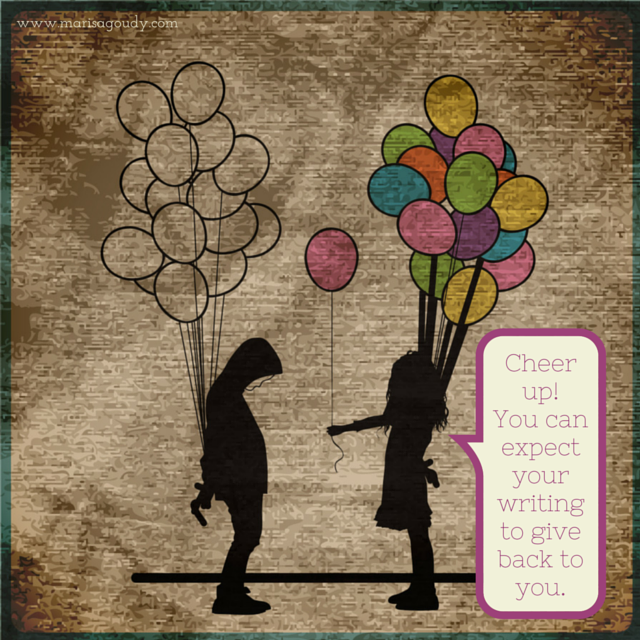 Good, consistent content supported by a smart, sustained online sharing strategy will build your business because that’s plain good marketing. But, if you expect more from your writing practice, you’ll receive even more in return.
5 Unexpected Benefits of a Writing-For-Your-Business Practice
- The writing process reconnects you with your “why” and helps you go deeper into the mission of your company and the meaning of your work. There’s no better way to stay true to the entrepreneurial adventure than through the personal exploration and public declarations that are inherent to this new art of online writing.
- If your mission is at the core of your business, writing also helps you explore the outer edges of the work. Drafting into “what if…?” style questions will reveal new possibilities and directions.
 You are able to speak more fluently about your work and what you have to offer in any setting - at an in-person networking event or in an online exchange where it’s appropriate to talk about how your company can help solve a problem
- For all that you may identify as a “creative” it can be easy to lose track of your creator’s mojo due to the demands of entrepreneurship. Writing is your chance to stoke the fires of your creativity while still remaining engaged in your business.
- When you start telling your business’s stories you’ll find yourself uncovering new aspects of your own story. Even if you don’t reveal everything in the public narrative, this sort of personal insight is invaluable and the essence of true success.
But Sometimes, the Writing is Still a Struggle
This post ended up being a killer to write.
I have a long term business project on my mind, my schedule is thrown off due to the snow, and life just wants my attention to be elsewhere.
Writing about how wonderful it is to write for your business seemed disingenuous as I had just peeled a crying baby from around my neck, thrust her into my husband’s arms, and growled “please, I just have to get these damn ideas on paper and then I will make dinner!”
This post ended up being the greatest test of my authenticity and my alignment to my own mission.
After a few false starts, I scrapped my original idea and wrote into the pain and frustration of having to write in the first place. I railed a bit against the content creation imperative and my own self-imposed editorial calendar. I ranted about how hard all this was and how thankless it all felt.
Most of what I wrote was garbage and only a few phrases will appear here in the final draft, but in that for-my-eyes-only scribbling, I caught a glimpse of why I’m doing all this.
As much as I kept saying I felt guilty for abandoning my teething babe and for admitting that I didn’t want to hear my kindergartener practice whistling any more, I needed the break. Only the “mama just has to get some writing done” announcement would secure me passage to the quiet oasis on the other side of my office door.
The writing practice is a demanding one, but it's all the sweeter for the sweat it occasionally demands. I see the greater worth in the process and only by walking through its fires can I emerge on the other side, honestly able to tell you that you can stand the heat and you will create something important.
Is Your Business Sustainable? Your Writing Practice May Reveal the Truth
I wrote myself out of my fevered angst and ended up feeling better when I took my own medicine, but what if writing for your business never seems to get easier or offers up the fringe benefits I describe above?
You deserve (and need!) a business that you can maintain. It may not all be effortless, but, ideally, your work only requires the smallest degree of push and strain. Content marketing (ie. blog writing, podcast production, YouTubing) is key for anyone who wants to drum up business online and it will take up a portion of your workweek when you’re taking it seriously.
If you feel like writing for your business is a constant “<sigh>, if I must,” something is wrong. This sort of resigned martyrdom will come through what you write and you’ll never get the results you hope for.
I’d love to help you through this struggle. Contact me and we’ll set up a brief chat to clear away some of your writer’s blocks and come up with a few solutions so you get more than just a blog post out of your next writing session.
The Words You Use - And Won't Use - To Describe & Market Yourself
The Sovereign Standard, Issue 4
Today, the one sure way to fail is to be boring. Your one chance for success is to be remarkable.
Seth Godin wrote that in Fast Company in 2003 when he was promoting his then new book, Purple Cow. Essentially, he was telling marketers and entrepreneurs that they had to be one thing: remarkable.
In the last 10+ years, this has only become more true and more important. And because you’re a creative entrepreneur who tunes into the Godin Oracle (or someone emulating him) you take great care to prove that you’re a horse - or a cow - of a different color.
And So It Begins: The Quest for the Unique Job Title
Thank goodness we’re past the days when women were limited to “nurse” or “teacher.” Now, both women and men have the opposite problem. A whole new world of work has emerged in less that a generation - but so have the tongue twisting titles.
This article pokes fun at the self professed “Digital Overlord” and the “Change Magician“ - actual job titles people have posted on LinkedIn. It’s easy to giggle at the “Wizard of Light Bulb Moments,” but then you might start to worry that your creative title could seem just as silly to the uninitiated.
To return to Seth and his barnyard:
We face two choices: Either be invisible, uncriticized, anonymous, and safe or take a chance at true greatness, uniqueness, and the Purple Cow.
At least the “Retail Jedi” mentioned in that “gotcha” post got noticed. And even if that guy was lampooned, there just might be a Leia out there who’s having trouble moving her back inventory of Ewok treats who really needs a lightsaber-wielding, product moving savior.
If you're remarkable, then it's likely that some people won't like you. That's part of the definition of remarkable. Nobody gets unanimous praise — ever. (S.G.)
Choosing the Right Words for the Right Reasons
The choice to devise a unique title for yourself or your work isn’t just about marketing. It is also about owning your story and the space your business occupies in the hearts of your perfect people.
 My word? Sovereignty.
I’m taking a term that generally refers to heads of state and absolute authority, and giving it a new meaning for the contemporary creative entrepreneur.
If you’ve been wondering what’s behind my sovereignty story, I invite you to spend some time with this post - I’m terrifically happy with where all this is heading and I want you with me from the beginning!
And since we’re redefining sovereignty for the 21st century - crowning ourselves and ruling our own lives without impinging on the freedoms of others - we also have the opportunity to name ourselves. (Wouldn’t Louis XVI be jealous?)
So let’s do it, right? Open up the dream journal and pull a thesaurus off the shelf. It’s time to christen yourself a "Manifestation Magnifier"!
(Hm, or is it?)
Say you're a coach. How many coaches have received credentials in the last decade? If there are any industries that demand a creative personal title, life and business coaching are at the top of the list.
In a crowded marketplace, fitting in is failing. In a busy marketplace, not standing out is the same as being invisible. (S.G.)
Who wants to be an invisible coach? You end up lonely, broke, and suffering serious creative congestion.
If there’s power in naming - religion and literature surely prove this - then it’s time to use all of your creative powers to give yourself a title that differentiates you from all the rest.
Or not.
Abby Kerr takes the “just don’t call me a coach!” lament head on. She asks:
But when did the desire to differentiate jump the shark? When is jazzing up your job title taking it too far?
Answer: when your colorful language clutters comprehension.
Agreed.
There’s a balance to strike between staking an original claim and picking something so unorthodox that people say “huh?” before they wander away to find someone who speaks their language.
The Balance: It’s Your Story, But the Buyer is the Hero
Chris Brogan’s “make the buyer the hero” concept can be applied in many different ways, like in this piece about making content marketing work. Ultimately, the work you do and the story you tell about that work (your marketing) isn’t about all the neat stuff you do. Instead, it’s about all the wonderful things a client will experience when she invests in your vision and your solutions.
 So, apply that perspective to the title you give yourself, your business, or your signature approach…
In order for a stranger to become the hero in the story of your business, she needs to feel comfortable enough with the theme, the plot, and the main characters. That means the first words she sees must immediately show her who you are and what your role is - in words she can understand.
What do people understand? The words that “everybody” uses. To return to Abby’s example: "coaching," not some polysyllabic invention.
A greater proportion of the public understands “pet psychic” rather than “animal intuitive.” It’s likely that “shamanic training” means more to them than “mystery school.” They’re looking for “marketing” not “buying community sustainable growth practices.”
Whose Story Is This Anyway?
Making the buyer the hero doesn’t mean you must be restricted to “the customer is always right” thinking or a contort yourself to fit the needs of the marketplace. It is, however, a good counterpoint if entrepreneurship - a deeply personal process these days - starts to become too personal.
Based on a realization that “ today’s marketing and business coaches are the therapists of the new century” Blair Glaser unpacks why entrepreneurism can be seen as the new therapy.
Blair's exploration rings very true… and I think the piece can serve to remind the "heart centered" business owner not to get so caught up in branding and self realization that the work and clear, well-considered communication gets lost in the process.
Yes, your creative entrepreneur's autobiography matters, but running a business isn't just about self expression.
So, how do you settle the "what's in a name?" question for yourself?
Personally, I don't have "coach" phobia. I didn't complete a program with dozens of other writing coaches all trying to pick the perfect colored cow - I gave myself that title based on my experience and expertise.
As I mentioned above, my word, my Purple Cow is Sovereignty. I apply the word liberally - to my newsletter, my #365project, and my developing products - but you won't see me calling myself a Sovereignty Scribe.
Ultimately, you set your own sovereign standard and you’ll have to decide whether clever trumps comfortable or vice versa.
What Your Creative Entrepreneur's Autobiography Reveals
The Prologue to Your Creative Entrepreneur's Story
 It’s not enough to dedicate your working hours to support someone else’s commercial dream.
Following the rules as they’ve been set out, and even doing the work you’ve been trained to do won't always sustain you. Not if it’s not yours. Not if it doesn’t have meaning.
You need to make things - a sculpture that will endure; a dinner that will linger, even if only in memory; a poem that describes a perfect moment in time. This creative process is usually more fulfilling than thankless, so you keep on reaching to find the true expression of your vision.
Soon, your private creative process resists being confined to the edges of your day. You feel restless, empty of purpose even as you're full of inspiration, and you're unable to conform to that workaday reality you tried to accept as "normal."
Like the creative imperative, once “I am an entrepreneur” lodges in your heart, you never quite escape it.
And so, you leap. Or you tiptoe. Or you stretch until you realize you’re prepared to open a business based on your passions, your art, and your calling to make something that matters.
Become Sovereign In Your Own Reality
Long before I had the courage to say “I quit!” and declare I had to design and control my own work life, I had my brushes with sovereignty.
I’d found myself in a rather un-magical world - newly married, working, spinning my wheels on a spiritual quest when I really wanted to fly to some other dimension. As I tried sort out how I was going to lead a meaningful life, I made my way to a place where I could dance with the unknown.
When my teacher and mentor declared the point of everything was to “become sovereign in your own reality,” I knew I’d found it.
The seed was planted, but then I kind of forgot about the epiphany. Since it didn't offer an immediate escape from the day job, I kept searching.
Though starved for attention, that seed survived. It nourished me through the start of motherhood, the death of my own mother, and the sudden freefall into entrepreneurship. It rooted me through the subsequent years of self-discovery as I dealt with all three of those events occurring in the span of a few months.
Your Creative Entrepreneur's Autobiography is Your Sovereignty Story
 It just may reveal the heart of your work - your sovereign story - in a way you've never understood it before.
It's going to be a story of hopeful meandering and dead ends, of running full speed in the wrong direction. You'll likely describe collecting blossoms of inspiration and losing sight of your creative dreams when immersed in busywork. There will be breathless successes, long pauses, and soul shaking defeats. You'll talk a lot about seeking, finding, and planting the seeds that you pray will deliver a good harvest.
Wandering is actually the most direct route to Sovereignty.
Whatever truths are illuminated in your creative entrepreneur's autobiography, recognize that there is a story to be explored and told, an historical map that needs to be drawn. This indispensable map will guide your next steps.
In looking to your own past, collecting the experiences and lessons and "ah ha!" moments, you gain perspective on where you truly stand today. With such an understanding you'll be ready to articulate the vision and craft the message that will take your work into a future that glows brighter thanks to your contributions.
It's possible to build a nice business without diving this deep into your history, your vision, and your reason for braving entrepreneurship. But didn't you leave that secure, "normal" world because you hated the way personal, creative expression and earning a livelihood were always held at arm's length?
Isn't it worth going deeper and going further?
 beyond unique. beyond engaging.
Be Sovereign.
As a creative entrepreneur, you do more than just run a business…
You dare to make a livelihood in service to your passions.
You speak your truth to a select tribe that yearns for a life more beautiful or bearable or bold.
You’re confident that your work has both value and magic... both describing it and getting it out there is a sacred mission.
So, how do you move from being a business owner who makes a nice living to standing sovereign - in your life and in the marketplace of ideas and products?
You find your stories. You write your stories.
You share the stories that generate a special, signature energy that sustains both you and the community that invests in your work.
Is there a specific formula for sovereignty?
The fullness of what it means for a creative entrepreneur to "be sovereign" is still revealing itself.
I discover something new every time I write into “what is sovereignty and what does it mean to me and the people I am meant to serve?” (I'm taking option #1 when it comes to deciding what to publish when I'm writing the bigger story and sharing what I can as the bigger ideas coalesce.)
If you have any stories about how sovereignty shows up in your life, please share in the comments. sovereignty is about consciously standing in your own story, but that's only possible when you're connected to other trees in your shared forest.
Meanwhile, follow along with my #365StrongStories project. Get the weekly digest full of inspiration for storytellers, entrepreneurs, and seekers of sovereignty.